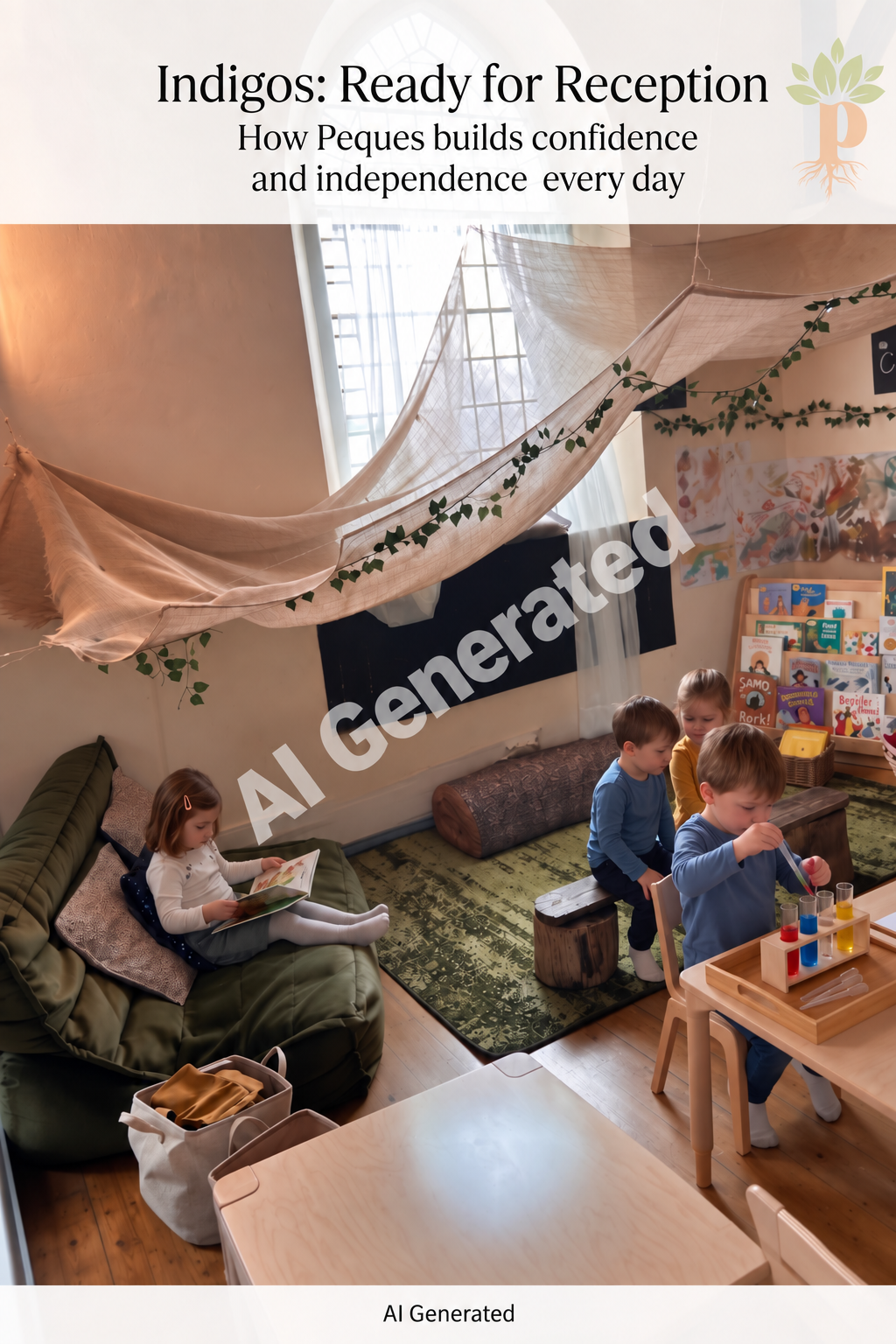
Ninety per cent of a child's brain development takes place between birth and the age of five. By their fifth birthday, the brain has reached almost ninety per cent of its adult size. Few facts about childhood matter as much as this one.
It means that the years a child spends in nursery are not a waiting room before real education begins. They are the years in which the brain is built. Every cuddle, every song, every conversation over lunch and every adult who kneels down to listen is part of that work.
Every Peques practitioner, across both of our settings, has completed training on brain development and how children learn. The course was developed by the Department for Education and shared with us by the London Borough of Hammersmith and Fulham, and we shaped it for our own team. We would like to share the heart of it with you, because families are the first and most important builders of all.
A brain that arrives ready to connect
The story begins long before we meet a child. In the middle of pregnancy, up to two hundred and fifty thousand new brain cells are formed every minute. From around twenty weeks a baby can hear, and begins to recognise their mother's voice. In the last ten weeks they are already absorbing the rhythm of the language spoken around them.
So a newborn is not a blank page. They arrive knowing a voice, familiar with a language and ready to connect. Babies can even be calmed by music they heard regularly in the womb. This is why, when a new baby joins us, we ask families about the voices, languages and songs their child already loves, and it shapes how every settling-in begins.
Again? Of course
Two processes do much of the building. Each time a child practises a skill, the brain lays down more of a substance called myelin along the pathways involved, and the skill becomes quicker and surer. Repetition is not a child being stuck. It is the brain strengthening its own wiring.
So when a child asks for the same story for the tenth night running, pours water from jug to cup over and over, or climbs the same step twenty times, they are doing exactly what they need to do. Our practitioners understand this and apply it daily, giving children the time and freedom to repeat something for as long as they need rather than moving them on too soon.
Alongside this, the brain clears away the pathways that are never used. What is used grows stronger. That is why variety matters as much as repetition, and why our rooms offer music, movement, stories, time outdoors, and English, Spanish and Mandarin heard naturally through the day. Rich and varied experience in the early years keeps pathways open.
Why a two-year-old cannot wait
The part of the brain responsible for planning, decision making and impulse control sits just behind the forehead, and it goes on developing into our twenties and beyond. When a two-year-old cannot wait, cannot share or cannot stop, it is not defiance. That part of the brain is simply not built yet. Until it is, children borrow our calm.
This understanding changes how adults respond. At Peques we do not label children. When behaviour challenges us, the question we ask is not what is wrong with this child, but what this child has experienced and what they need from us now.
Needs first, then learning
The psychologist Abraham Maslow taught that basic needs must be met before learning can happen. A child who is hungry, tired or frightened cannot learn, however beautiful the activity on the table. Settling a child, feeding them well and welcoming them by name is not something that comes before the learning. It is its foundation.
Food is part of this in a very direct way. Iron is essential to the building of myelin, and predictable mealtimes allow a child to relax. Our own kitchen prepares homemade, balanced meals every day, and the calm, sociable mealtimes around them are part of how we care for children's brains.
Movement belongs here too, because brain and body develop together. NHS guidance is thirty minutes of tummy time a day for babies from around three months, and at least three hours of activity a day for children aged one to five, with an hour of that lively enough to leave three to five-year-olds a little out of breath. Running, climbing and dancing build language, problem solving and friendship as well as strength.
Learning happens in relationship
Lev Vygotsky showed that children learn with and through other people. Real learning happens just beyond what a child can manage alone, with someone beside them offering the smallest piece of help and then stepping back. That someone may be a parent, a grandparent, a practitioner or another child, and in our multilingual rooms children are very often teachers to one another.
Albert Bandura showed that children learn by watching. How adults speak to one another, how we greet a family at the door, how we cope when something goes wrong: all of it is being learned. Our practitioners carry this awareness into every day, because the respect we show one another is part of the curriculum.
Bandura also reminded us that resilience comes from overcoming obstacles. When a child is struggling with a zip, a puzzle or a friendship, the kindest response is not always to solve it for them. Sometimes it is to stay close and believe in them.
When the start in life is harder
Not every child begins from the same place, and our training addresses this honestly. We share what follows not so that any family is judged, but because understanding different starting points is part of caring well.
Some influences come before birth. Illness in pregnancy, smoking and alcohol can all affect the developing brain, as can a shortage of oxygen during labour, while folic acid and omega three support healthy development. NHS guidance is to avoid alcohol in pregnancy altogether, because a baby cannot process it. Anyone expecting a baby will find their midwife or GP the best source of personal advice.
Other influences come later. In 2021, 3.9 million children in the United Kingdom were living in poverty, and children in low income households are three times more likely to experience mental health difficulties. Abuse or neglect, domestic abuse, mental ill health or substance misuse within a family, or the death of a parent or sibling can place a child under prolonged strain known as toxic stress. It can alter how the brain develops, and may show itself in sleep, concentration or behaviour.
Here is the message we hold on to most firmly. A safe, secure relationship with a trusted adult, together with positive experiences, can buffer toxic stress and help to reset a child's stress system. This is why the key person matters so much at Peques. For some children, that steady adult is what makes the world feel safe enough to explore.
Our practitioners are also trained to observe closely and to act. A missed milestone is not automatically a delay, so we first make sure a child has truly had the opportunity to develop the skill, offer the right experiences and watch for progress, and work with families and specialists where more support is needed. Where a practitioner has any concern about a child's safety or wellbeing, it is passed to the Designated Safeguarding Lead straight away, in line with our safeguarding policy.
What families can do at home
None of this requires special equipment. Talk and sing to your baby, before birth as well as after. Read the same story again, gladly. Let your child wrestle with the zip for a moment before you help. Keep mealtimes and bedtimes predictable. Notice and name exactly what your child did well. And remember that they are watching how you treat the people around you.
Our commitment
We take the first five years seriously because the science leaves no room to do otherwise. It is a commitment we make to every child in our care, to their parents, carers and grandparents, and to the wider community these children will one day shape. Helping to build the brains of an international generation is a privilege, and our practitioners treat it as one every day.
If you are an early years practitioner who recognises yourself in this way of working, we would be glad to hear from you. Our current vacancy is at peques.co.uk/workwithus, other opportunities arise during the year, and you are welcome to write to us at careers@peques.co.uk.
Both of our settings are close to capacity. Places are offered first to siblings, then as temporary spaces, and then through our waiting list, and visits take place by personal invitation. Families who would like to be considered are welcome to contact us at peques.co.uk/contact.
← Back to the Blog